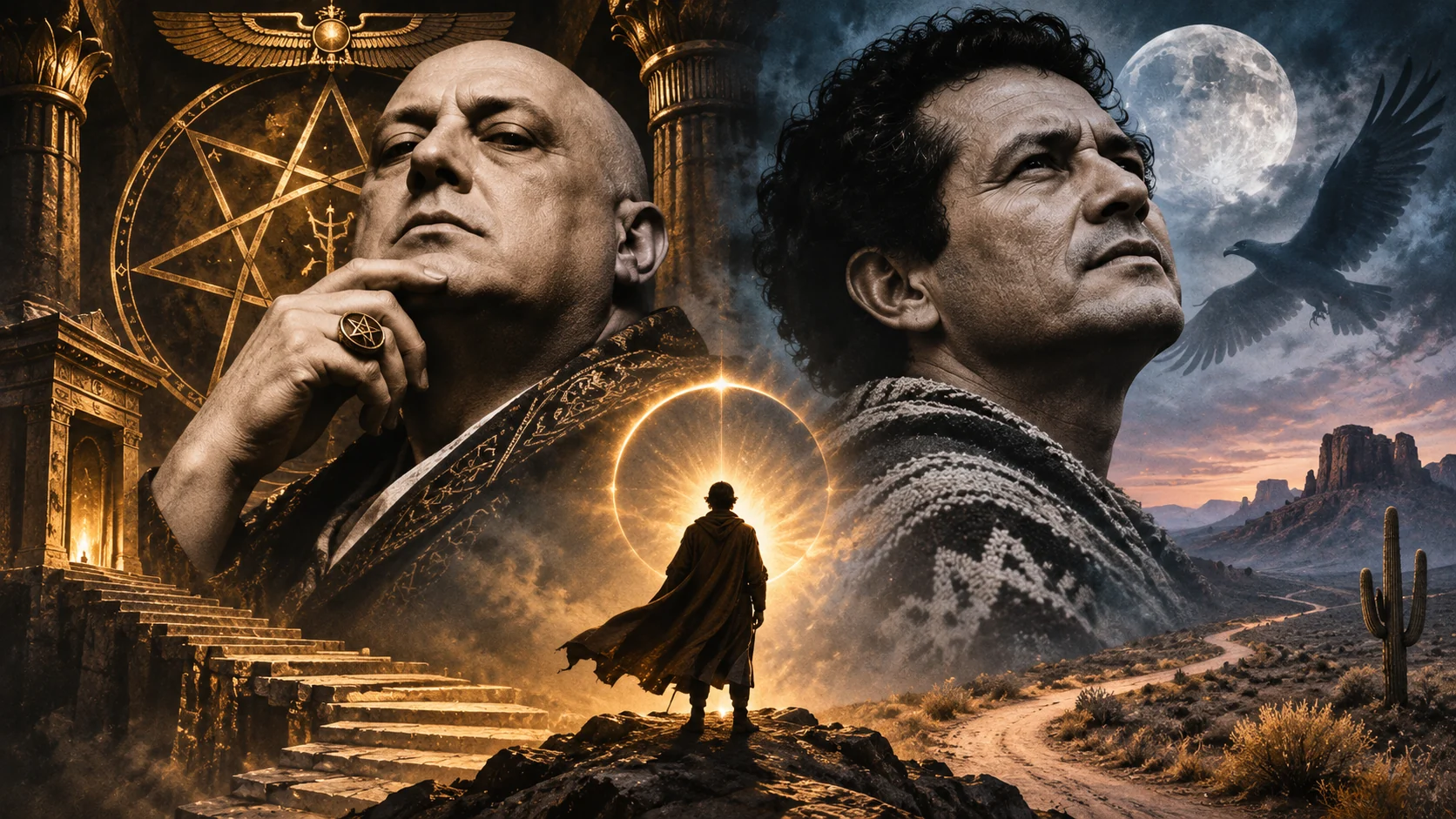
Crowley versus Castaneda: destruction without meaning and ascent through Will
Destroying yourself is easy. But only someone who builds after the destruction deserves to be called a magician.
Some paths lead upwards; others lead sideways, past the goal, into emptiness.
Castaneda’s teaching is a sideways path: a path on which destruction is presented as victory, flight as initiation, and narcissism as secret knowledge.
But Crowley says: do not run. Stand up. Accept the light upon yourself—and pass through the night. Where another person disappears, the magician begins to exist.
The Narcissistic Trap of Castaneda
Castaneda says: “erase your personal history”, “be nobody”, “become empty”.
But behind these formulas lies another, more sinister one: be exceptional.
Be the one who has realised that the world is a trap. The one who has left. The one who knows more.
This is narcissism of a new kind—not boastfulness, but a sense of mysterious superiority.
You are the chosen one. You are the warrior. You stand apart.
Such a person is not concerned with truth. What matters is being unlike everyone else.
In philosophy, this is called negative transcendence: not an ascent towards something higher, but a fall into the abyss disguised as an ascent.
Nietzsche might have said: not the Übermensch, but a beast with a human face.
Destruction for Its Own Sake
Castaneda destroys the personality. He annihilates memory, feeling, connection with the world, love, ancestry, meaning.
But he builds nothing in their place.
There is no Order. No Idea. No Will arising from the depths of the Universe.
Only an energetic scheme: survive, observe, accumulate, leave.
This is anti-philosophy.
All ancient wisdom—from Plato to Heidegger—says that a human being is a creature who questions Meaning.
Castaneda, by contrast, teaches you not to ask. He teaches you to close your eyes, pretend to be a shadow, and disappear without a trace.
But someone who destroys the inner human being without building a new one turns themselves into an empty shell.
That is not enlightenment. It is disintegration.
Crowley: the Path of Will, Not Escape
Crowley, however, says something different.
He knows that the ego is a trap. But he does not flee from it—he burns it in the alchemical fire until only salt, essence, and gold remain.
This is the opus magnum, the Great Work, in which the Personality is cleansed not of memory but of lies; not of love but of slavery; not of feelings but of masks.
True Will is not what you want. It is what you are within the greater meaning of the world.
It is a law inscribed in the flesh. A star guiding you through chaos.
It does not require stalking. It requires a courageous Yes.
A Philosophy of Light or a Philosophy of Shadow
Castaneda offers a philosophy of shadow: disappear, become nobody, hide, hunt.
Crowley offers a philosophy of light: walk the path, become one who carries Will and unites heaven and earth.
In Castaneda’s vision, the magician is cold. He does not love. Does not suffer. Does not live.
He is a faded copy of a human being.
In Crowley’s vision, the magician burns. He desires, suffers, dies, and is reborn.
He is both sacrifice and victor, instrument and star.
The Essence
Castaneda’s teaching is a narcissistic cult of destruction disguised as wisdom.
It is a path without a goal, action without a reason, disappearance without justification.
Crowley’s path is harsh. Dangerous. Full of trials.
But it is a path towards Meaning.
It elevates the human being. It demands pain—but brings Knowledge, Love, and Will.
Do not walk into emptiness. Walk towards yourself. Towards who you were before the beginning of time.