
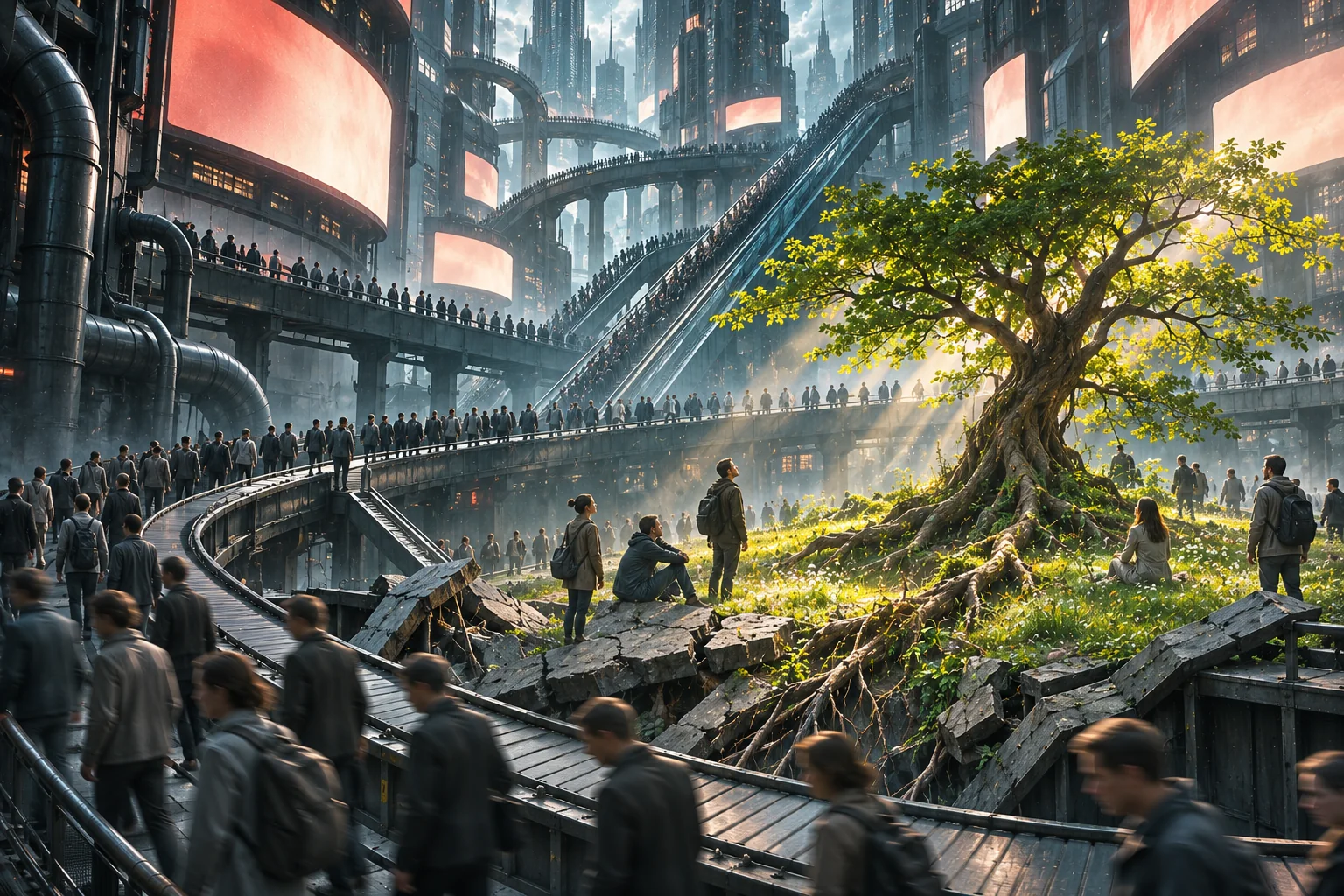
We live in a consumer society, and that, unfortunately, is the highest meaning capitalism has managed to squeeze out of itself. Capitalism has outlived its usefulness. It was needed as a system of accumulation and was initially ideal, but everything has a beginning and an end. The end of capitalism is marked by the social perversions of consumer culture. Today everything is a commodity. Your travels around the internet are a commodity, your likes are a commodity, your hobbies and interests are commodities, and your private life is a commodity. Today it is impossible to stay “clean” on the internet without sacrificing convenience. Everyone leaves a trail, and that trail is recorded and sold, so that Big Data can be used to sell you something. Or, in the most extreme case, to blackmail you.
Have you noticed how many “spiritual courses” there are now? An incredible number, most of them empty shells. And what do the “spiritual gurus” offer? The same satisfaction of the Animal Soul: success for the sake of success and prosperity, the lower needs of Maslow’s hierarchy. The meaning of freedom has degenerated into the meaning of accumulation. Give me more, and plenty of it! Give me energy, give me fabulous magical powers, give me obedient demons and enslaved spirits! Spiritual experience has been reduced to the level of I Want. A culture of looking towards the future, a culture of creation, has degenerated into a culture of hoarding and stagnation.
Why did this happen? Why did what was, in essence, the good idea of a free market fall into such cultural decline? The answer is simple: the goal shifted from freedom to accumulation and preservation. It is no secret that global markets have long since been carved up, and it is almost impossible to enter them without creating your own blue ocean—and even there the choices are limited. And when a market is effectively controlled by a handful of large concentrations of capital, only one way of surviving remains: accumulating and holding on instead of developing further. Why develop anything when your cash cow is already bringing in superprofits?
Look at Apple, a splendid example of a cash cow. The deliberate slowing of technology: they reached a ceiling long ago, and today you can hardly tell an old iPhone from a new one. When that happens, they start stuffing products with “bells, whistles and fart noises”, as developers put it. What have you seen that is genuinely new in social-media or banking apps? Everything is just brighter and more fashionable, but in substance it is no better.
And the same is true in every area of life. Television shows, video platforms occupied by pseudo-intellectuals, spiritual rubbish sold as the one true truth. Everything serves to maintain the desires of the Animal Soul. Don’t look up! You don’t need a soul. You’re an automaton, and you must reach a certain position in society, you must earn more, you must become spiritually wealthy, you must master your neurosis!
All these prescriptions built around “you must” are themselves among the symptoms of neurotic disorders. With that constant “must” comes the managers’ disease—neurasthenia. You must do this, you must do that. And then disappointment, emptiness and an insatiable hunger for more desires.
And after such reflections, plenty of materialists who cannot think beyond the level of an automaton start pointing us towards socialism and the USSR, claiming things were good there. Yes, wonderful: everyone cut to the same pattern, the same clothes, the same fish-patterned crockery in the home and in the movies, the same opinions. Under the Soviet Union there was cultural stagnation too. Open a scientific book and you find quotations from Lenin and Marx in medical literature! Two great luminaries of medicine, no doubt! Why? Because existential meaning had disappeared. It all became a cargo cult: we pour out quotations because we are supposed to see the correctness of the path in everything, even a book on programming or steelmaking.
Stagnation in the Soviet Union began after the war, when the great goal of Victory had been achieved, when the great goal of rebuilding everything had been achieved, when the body’s lower needs had been satisfied. Then the existential question arose. And what were people told? The price of sausage has been reduced! So a person lives like a biorobot, working for a Czechoslovak wall unit and Yugoslav boots. This is philistinism, and philistinism respects no economic or political boundaries. It is the condition of satisfying the Animal Soul.
Meaning, Desire, and Moving Forward
And here we come to the natural conclusion: a human being cannot develop under any social system or economic model until they begin to discover their own meanings that will move them forward. You cannot force this at the point of a stick. In the Soviet Union people were made to find the correct quotations, but that did not produce existential meaning.
Let us look at the twenty-first trump of the Tarot de Marseille: The World. On the left is the past; on the right is the future. The Eagle of meanings stands ahead, in the future. The Lion of desires is also in the future. Our feelings, memories and sense of beauty are in the past; so is the body, represented by the Bull. The Eagle seems to tell us, “How good it will be.” The Angel says, “How wonderful it was.” The Lion announces, “I want it to be good.” And the Bull declares, “It was good.” They seem to be saying the same thing, don’t they? That is the first trap that not a single novice running “spiritual growth” courses can escape. And now you will see why.
The Eagle looks towards the future. It knows that things will be good, and answers the question “how will it be?”—how to do it, how to get there, how to make it happen. The Eagle always represents ideas on a global scale, even in the most limited sense. For example, this article matters to me existentially. It is something grand and far-reaching within my own small world.
The Angel looks back and says, “How it used to be.” Again the question is “how”, but now directed towards the past. Here lie our memories and the pressure exerted upon feeling. Pressing on people’s feelings is a favourite trick of degenerating esotericists. Let’s remember how wonderful Atlantis was! But where is the aspiration to move forward? Where are movement and development? Our universe is constantly in motion; our planet and the Sun are moving too. Yet you are sold nostalgia, told that there once were glorious times and that we will bring them back. Doesn’t that sound familiar? Let’s turn back time! But can we really return to the past? We can, provided we destroy your soul and stuff it with hungry spirits—after all, it’s so pleasant when your heart aches with nostalgia, isn’t it?
The Lion, however, does not really worry about the future. It is preoccupied with the past, because its task is to satisfy the Animal Soul, and the Animal Soul is built entirely upon cognitive associations rooted in past experience. Remember your fleeting desires: they always appeal to the past.
The Bull—the body—asks no questions at all. It merely states a fact about the past. Like our body, the Bull has no interest in the future; for the body, the future means moving from birth to death. The body is always about the past. Try catching yourself in bodily thoughts: they are always connected to past experience. When the desire-Lion is aroused, it turns to the body-Bull, which reports whether things were good or bad. The Lion then either becomes excited by that desire or cuts it off.
Now let us look at the degree to which modern esotericism has degenerated. Rather than seek the Eagle’s new horizons, its practitioners tell you that you must be made comfortable: “I want things to be good.” Right? The Eagle is a phantom, while the Lion relies on experience, so you immediately think: yes, the right rituals are those for wealth and possession! And what is that if not philistinism?
Others do the opposite, talking about “how wonderful things used to be”, how magnificent their mythical Atlantises were and how we must return to those roots. Return, in the broadest sense, is always degradation. Making the past your existential purpose is a road to nowhere. Memories should remain memories. We need them as a foundation from which to move on. It is the Eagle’s direction that suffers most. But merely marching towards a radiant future is no solution either: a fantasy of a bright future on television is quickly defeated by an empty refrigerator.
The World card told us this long ago. Look again at the Maiden. She rests upon the Bull and the Lion, while the Angel and Eagle occupy her thoughts. She is clearly moving forward into the future, her body directed that way, but she looks towards the Bull. It is through the body that we can experience the future—not through the Eagle’s fantasies, wandering into imaginary worlds; not through the Lion’s desires, becoming dependent; not through the Angel’s feelings, sinking into melancholy. Only the body is our key.
The Spiritual, the Bodily, and Life Here and Now
Here is another misconception among spiritual novices: that they will spend their lives running around in dream worlds—hello, lucid dreaming!—or somehow drag the spiritual into the physical. Yet another sign that they do not understand the processes at all. I have seen so many mad astral warriors, but not one has ever been able to demonstrate their power to me. Just storytellers who have come to believe their own delusions.
That is precisely why I tie my exercises to the body. It is on the physical plane that I always concentrate attention during rituals.
Meditation without a bodily foundation is fine for relaxation. But if you want something deeper, focus on feelings, bodily sensations, smells and the like. In this way we bring the psychic plane closer to the physical. This is what all those fantasists are missing.
The World card shows us the key to wholeness. But amid all that symbolism, we must not miss the main point. Whatever the reality surrounding you, it will not become qualitatively different until you change your attitude towards it. A great deal of money will not make you happy if you have to work twelve hours a day, seven days a week, to earn it. Those stories about billionaires working twelve hours a day are just stories. They became rich through chance, through self-organisation, through a million different reasons that, for one reason or another, may not be available to you. But have they become any happier in a meaningful way? To my mind, Pavel Durov is perhaps the only one who looks happy and balanced. He does not seem to concern himself with all this “successful success” nonsense but lives in harmony, as far as one can judge. Happiness is not about driving yourself to the limit so that, someday, you can finally enjoy something.
Happiness is right here, in front of you as you read these words. You are reading now, and you are aware that you are reading—in this moment, not in the future and not in the past, but “here and now”. Like the Maiden in The World card, who is also “here and now”.
So enough falling into neurotic states and brooding over the past. We look ahead, accepting the experience of the past while orienting ourselves towards the present.